
The TÜBİTAK 4009 Project on "Healthy Living and Conscious Technology Use Workshops in Village Schools" was implemented at Kocaaliler Middle School
Date | 30 September 2026, Wednesday

The project titled “Healthy Living and Conscious Technology Use Workshops in Village Schools”, prepared by the Addiction Prevention Coordination, was accepted within the scope of TÜBİTAK’s 4009-Village Schools Support Program. The project is led by Assoc. Prof. Dr. Sevinç Sütlü and Lecturer Özge Kutlu, while Lecturer Nida Nur Ekici, Lecturer Dr. Mine Ömercioğlu, and İrem Azak were involved in conducting the workshops.
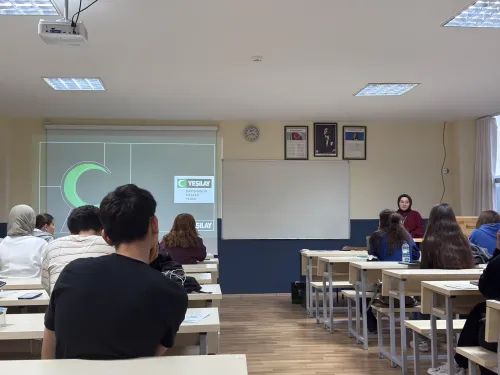
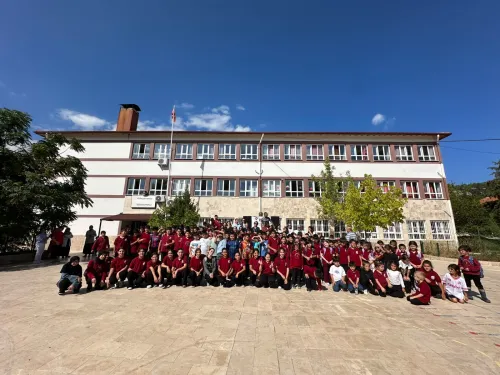
Within the scope of the project, two days of workshop activities were held on September 24-25, 2026, at Kocaaliler Middle School to support students' healthy living habits, increase their awareness of conscious technology use, and create protective awareness against addictions at an early age.
The activities were carried out with a station-based and experiential learning approach that emphasizes active participation of students. Students participated in applications related to healthy choices through experiments, physical activities, attention and reflex applications, intelligence games, and daily life scenarios at different stations. In line with the project's main approach, the issue of addiction was aimed to be addressed not only through information but also through students gaining awareness via scientific discovery and experience.
In the “Heart and Movement Workshop,” students observed the effects of movement on the body by measuring their pulse before and after physical activity; they participated in applications aimed at developing balance, coordination, and movement skills in the physical activity course.
In the “We Know Our Brain and Attention-Reflex Experiments Workshop,” the functions of the brain in attention, decision-making, and movement control were discussed through a brain model, while students experienced focus and reaction times with attention and reflex applications.
In the “Screen Light Experiment and Virtuality Awareness Workshop,” students observed the effects of screen light on the eyes through experiments. While information was provided about healthy screen use, screen breaks, eye relaxation, and the 20-20-20 rule; awareness activities were also conducted on questioning the information encountered in digital environments and safe internet use.
In the “Smart Choices and Intelligence Games Workshop,” students participated in educational games aimed at distinguishing healthy and unhealthy behaviors through daily life scenarios. The aim was to support correct decision-making, analytical thinking, focus, and social skills through team-based games and intelligence activities.
In another part of the activities, the “Science Workshop with Experiments” allowed students to explore the relationship between science and daily life through various experiments. Applications were conducted to materialize the cycle of addiction, in addition to soap making, detective work, air games, and science doctor experiments.
Through the workshops held over two days, students were contributed to gaining awareness on healthy living, physical activity, conscious technology use, attention, correct decision-making, and scientific thinking. The project aims to contribute to the dissemination of similar practices to different village schools within the framework of university-community collaboration.